
Escape the Box
There is a trick our brains tend to play on us.
Once you see it, you can’t unsee it, and you will start noticing it everywhere.
✉️ Get the Infinite Impact
Join thousands getting weekly wisdom on unlocking hidden potential, building meta-abilities, and creating meaningful change through practical frameworks you can use immediately.
Finding The Secret Rules
One of the things I always found challenging about having an actual job (like, one where I had an employer) was the ever-present list of expectations about what was deemed “correct.”
Some of these behaviors or skills were communicated, and possibly even documented.
Some were completely unspoken. It was as if there was a secret handbook I didn’t have access to. Or like I was taking part in an inverse scavenger hunt, one where finding something from the hidden list meant reprimand.
I was praised for expertise that moved things forward and given warnings for my oversights, regardless of whether the mistake had any consequence whatsoever.
Hidden in these experiences are two important lessons. One about people and one about math.
The lesson about people
There is an idea that will seem obvious to most adults. It is called the Theory of Mind.
In short, Theory of mind is a concept that describes the ability or capacity to understand that other people may have a different way of seeing the world due to their beliefs, experiences, and other factors. Look around any office, coffee shop, or birthday party, and it’s not a hard idea to wrap your head around.
Yet, it is remarkably easy to find people behaving in a way that runs directly counter to a working theory of mind. Over the course of my career, I’ve seen it countless times in the words and actions of managers. I’ve heard it every time someone says the words “why can’t you just…”
Because embedded in those words are three assumptions…
- Everyone else’s brain is probably just like mine; and
- if I can do it, they can do it; so
- if they can’t do it, then they are wrong and must be fixed.
The Formation of Boxes
Because complex problems require more energy, we tend to try and expedite the path to solutions in order to conserve energy.
In order to reduce complexity and make sense of things, people will often try to simplify things with categories and rules.
When choosing the rules and categories, people can’t help but start from their own perspective. Inevitably, when given the choice, people will often designate the boxes they are in, which is the one that feels natural to them, as “correct.”
Unfortunately, these categories, useful as they might be, can also become a self-justifying delusion that limits our capacity for collective greatness.
The lesson about math

If you were to poll two people, how many questions do you need to ask before you are almost guaranteed to get different answers? What about 100 people? What about 100,000?
The answer to these questions is a combination of the number of questions asked and the number of answers you allow.
For example, if you were to tell your team of 20 people that everyone must meet in person for all communication, you have 1 available option for all 20 people.
If you then ask whether they would prefer to have in-person meetings or communicate via Slack, you have doubled the number of available options and are far less likely to have unanimous agreement on one option. Add more options, and you are even less likely to have large groups in exact agreement.
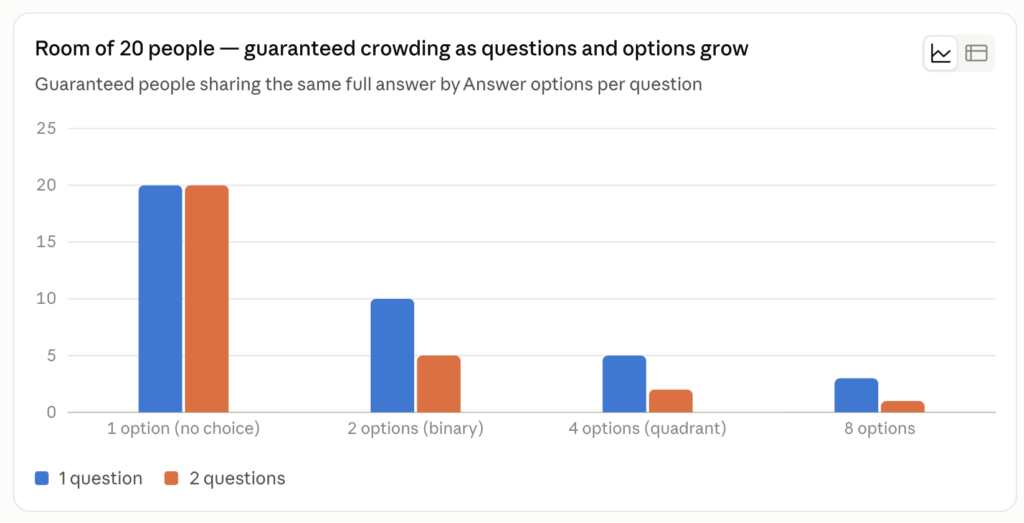
But whether you change the questions or options, you still haven’t changed the actual number of preferences. Only the number of acceptable outcomes.
It turns out that when you stop asking binary questions, you quickly realize that everyone is completely unique, even in a company of 100,000 people.
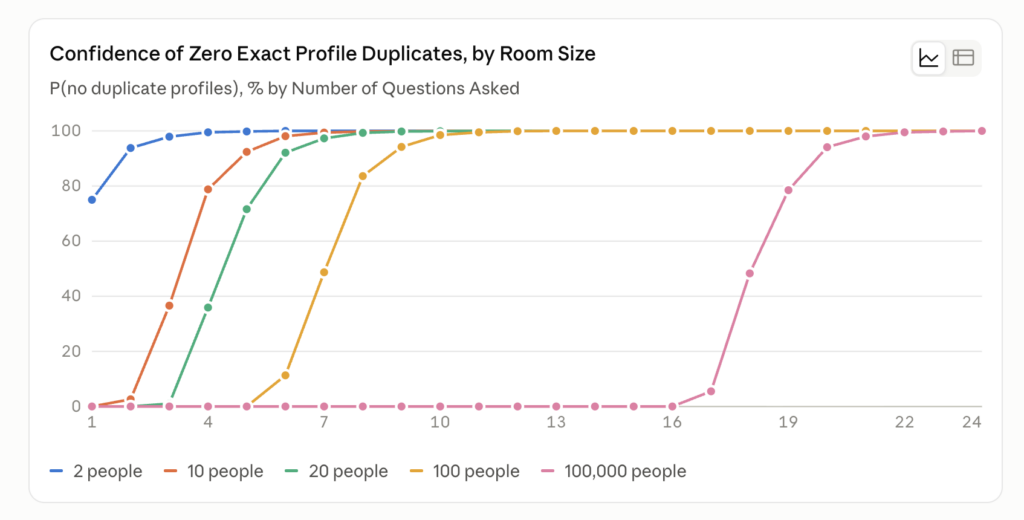
That’s the important thing to understand about the categories and rules at work. It’s most often an illusion of a dominant “right way” which is really just a disguise for the preferences of someone with a better title.
Blind Standards
This is how we end up with standards that hurt more than help.
I see this most clearly with prospects who come to us already certain of what needs to happen. We’ll demonstrate how an inclusive approach leads to better results with more people getting what they actually need, and they recoil at the idea. To them the answer is simple: “here’s how you do it, here’s what we need, we don’t need any of that other stuff.”
Even when the option to give someone what they need is already there, it might get blocked because someone else is convinced their way is the right way, simply because it’s the way they’d choose.
Slippery Slopes
So, does this mean we need to cater to everyone?
In all fairness, it’s a tall order to build a custom solution for every single preference someone might have.
But whether we make the extra effort should probably be a question about whether it gets a better result, instead of whether it falls outside of the current options.
We should be wary anytime we’re more focused on controlling how people do things, instead of what people need to thrive combined with what’s actually achievable.
Otherwise, it’s the person who wasn’t built into the original rules who inevitably pays for it.
Inventions and interventions
One formal way we can address this problem, is by walking teams through the process of building a short user guide.
This is a structured set of questions that, unlike assessments that sort people into a shared label or bucket, combines multiple dimensions to produce a unique, individual profile instead of group membership.
This is one documented way of going through the process, among many possible ones. I’m actually running a workshop on it this coming weekend in Dallas, where people go build their own.
But the tool isn’t the point. The point is to break the spell.
Break the spell
Once you catch yourself under this spell — assuming everyone else’s brain works like yours, sanding down the full range of real answers into a “correct” one and a “wrong” one — you can start to interrupt it. And once you interrupt it, you start asking questions instead of making assumptions.
You don’t always need a formal system. It can be as simple as noticing when you’re offering people too few options to actually tell you who they are or what they need.
Start by presenting more options. Try adding something like “it depends,” or an open write-in option, so people aren’t stuck selecting from a predefined list.
The point is to take your thumb off the scale, and let people tell you who they are and what they need to thrive. It beats making assumptions from your own perspective.
When you increase the number of available options, you invite people to stop hiding and stop pretending. Once you do that, you can make better decisions with more honest information.
Maybe most importantly, it frees everyone from the mathematically impossible fantasy that there is a correct way to be in order to thrive.
I hope you enjoyed this post!
If you liked this post, then you will LOVE my newsletter (The Infinite Impact)
and my learning community (The Superhero Institute).
⚡️ Join for free or upgrade to get even more

✉️ Get the Infinite Impact
Join thousands getting weekly wisdom on unlocking hidden potential, building meta-abilities, and creating meaningful change through practical frameworks you can use immediately.
