
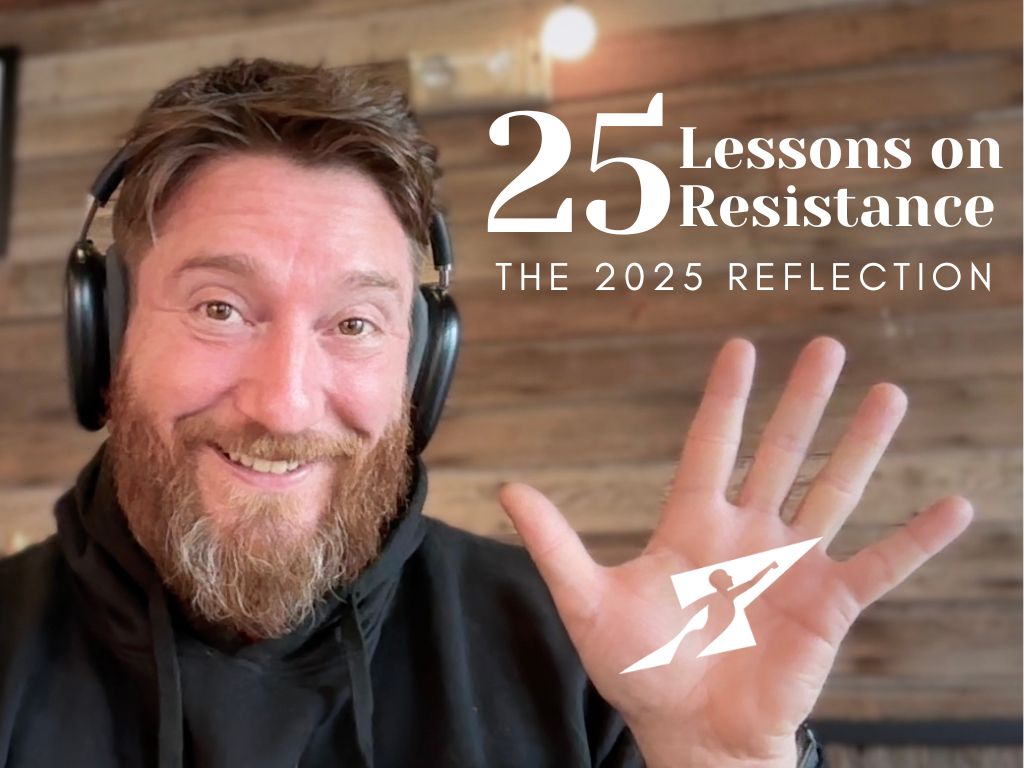
25 Lessons on Resistance (The 2025 Reflection)
As I looked back on all of my posts from 2025, it became clear that this year was about resistance.
Each week, as I sat down to write a post, I always found myself thinking about something bigger than productivity hacks or personal optimization. I refused to normalize cruelty by going about business as usual.
Over and over I found myself thinking about collective action and how much more powerful that is than any individual genius. We don’t need solo saviors, we need heroism as a team sport. That requires people who’ve developed themselves to make collective power possible. We need empathy grounded in each other’s humanity, communication that builds bridges instead of walls, critical thinking that protects us from manipulation.
So, I went back and pulled 25 lessons from this year. These aren’t commandments but rather invitations. To you, I offer that there are a lot of ways to change the world, and these are the ones from this past year that I think matter most.
✉️ Get the Infinite Impact
Join thousands getting weekly wisdom on unlocking hidden potential, building meta-abilities, and creating meaningful change through practical frameworks you can use immediately.
Foundation: The Meta-Abilities
1. Communication serves as the building block for nearly every consequential skill
Communication serves as the building block for nearly every consequential skill––teaching, persuasion, leadership, all of it.
Remember The Platinum Rule: determine your specific goal before you ever start communicating.
And never forget that humans aren’t machines. The emotional state of the person receiving a message is as vital a part of the effective communication equation as the intent of the person sending the message.
2. Critical thinking is your safeguard against manipulation
Critical thinking is your safeguard against political and corporate charlatans who rely on the absence of skeptical questioning. True critical thinking requires rigorous self-examination––checking your own ego, mood, and depth of knowledge before analyzing an external problem.
The structure and effectiveness of your thinking are always beholden to your underlying purpose: are you pursuing a factual truth or a specific outcome?
3. Empathy can be our default orientation
Treat empathy as a default orientation of care and curiosity, not as a manipulation tactic.
Empathy is “walking in another person’s shoes,” while sympathy is offering condolences from a safe distance.
Healthy empathy requires staying grounded in your own perspective so you can understand another person’s experience without being swept away by it.
4. Real listening is about seeking to understand
Real listening involves seeking to understand tone, subtext, and what’s left unspoken––not just waiting for your turn to talk.
To deepen any connection, practice asking “one more question” to go beyond surface facts, explore the emotions underneath, and pursue genuine understanding.
5. Courage is rooted in purpose
Courage isn’t the absence of fear––that’s bravery.
Courage is the act of moving forward even when you’re terrified. Naming a specific fear helps shrink its power, while leaving it vague allows it to grow and maintain control over your actions.
To access courage more easily, tie your actions to a larger purpose that matters more than the fear you’re experiencing.
Personal Work: The Internal Game
6. Self-acceptance becomes easier when reduced to a sequence of logic
Think of Self-acceptance as a sequence of logic that requires distinguishing between fixed traits (genetics) and malleable traits (skills) to decide where to invest energy.
Accept what you can’t change, work on what you can. It’s not that simple, but it’s a start.
7. Real self-care is a daily effort of making peace with yourself
Real self-care isn’t crisis management like buying a latte––it’s the daily effort of making peace with the critical voice inside your head.
Self-compassion is a practice, not a purchase.
8. Rest reveals what you’re actually living for
Rest isn’t a reward you earn or a weakness to overcome.
It’s a mirror.
It reveals whether your life is aligned with your values or if you’re just recovering from something soul-sucking.
Rest isn’t about sleeping more—it’s about asking what you’re resting from. Are you recharging for something meaningful, or just surviving something that drains you?
9. Growth flourishes when we reject a calcified identity in favor of becoming…
Fixed self-concepts are the enemy of evolution.
If you really want to grow, it requires a willingness to shed the old skin to step into your next state of being. It’s a conscious rejection of a “calcified” identity in favor of seeing yourself as a continual work in progress.
Stay in the process of becoming.
10. Human memory is malleable, so externalize what matters
Human memory isn’t a video recorder. It’s a malleable construction that can be updated or rewritten based on new information. One way to protect against memory degradation is to externalize information into a system. In my post, I talked about my “SuperBrain OS,” but you can use anything, so long as it is reliable and accessible so you can capture ideas and information as close to the moment as possible.
11. Joy triggers can break the spell of hopelessness
I defined a “Joy Trigger” as a radical habit that breaks the spell of hopelessness and existential dread by anchoring you in the present moment.
Find what brings you back to life and protect it fiercely.
Leadership & Impact: How You Show Up
12. The most effective leadership amplifies intrinsic motivation
High-performing organizations succeed by personalizing the person and depersonalizing the goal––treating every team member as a unique individual.
The most effective leadership looks for each individual’s intrinsic motivation instead of relying on extrinsic carrots (rewards) and sticks (punishments).
13. Love is a universal orientation that facilitates connection and softens conflict
Love is a universal orientation toward the world that facilitates connection, builds trust, and softens conflict.
Leading with love requires a conscious decision to view others as humans with their own fears and wounds before viewing them as threats.
Practice Love with the P.H.A.S.E. framework of five disciplines: Pause, Humanize, Affirm, Seed, and Expect imperfection.
14. Choose effectiveness over being right
Most people prioritize being “right” over being “effective,” choosing to defend their ego even when it damages long-term goals and relationships.
To break this pattern, pause and ask: “What’s the best way to achieve all of the outcomes I want as a person?”
Effectiveness and correctness aren’t mutually exclusive, but long-term success only occurs if effectiveness comes first.
15. Accessibility builds trust and expands your impact
Providing genuinely valuable free content doesn’t necessarily diminish your worth as it can also validate your expertise and build trust with potential clients.
The more people you reach, the more allies you gain for the work that matters.
16. Focus on value to increase prices so you have more time and resources for resistance
Premium pricing is justified when the value shifts from mere information to personalized guidance and deep, sustained expertise.
People pay premium prices for transformation, not information. If you’re going to charge high-ticket rates, make sure you’re delivering high-ticket results.
Premium pricing funds the resistance work that matters. Charge what you’re worth so you can afford to fight back.
Collective Action: The Resistance Framework
17. Real heroism is a team sport, not a solo performance
The myth of the solo superhero is seductive because it lets us imagine ourselves as extraordinary. But it’s also dangerous because it erases the essential contributions of everyone involved in any meaningful project.
Success is always a team effort, and glorifying “Super CEOs” or solo geniuses feeds an unhealthy addiction to hero-worship that keeps us waiting for someone else to save us.
18. To fight back against cruelty, we must resist normalization
Resisting normalization requires being anchored in a firm worldview that is “allergic” to the regular occurrence of cruelty.
Don’t let the unacceptable become acceptable just because it happens frequently.
19. Political violence includes systemic policy decisions that restrict rights
Political violence isn’t just sensational acts of physical injury––it includes systemic policy decisions that restrict rights or deny healthcare.
Understanding this broader definition is essential for recognizing how power operates.
20. Make them say their problematic garbage out loud
Take the “Spell It Out” approach and forces critical thinking by asking people with harmful ideas to define exactly what part of a slogan or acronym (like “Diversity, Equity, and Inclusion”) they find problematic.
It puts the burden of proof back where it belongs.
21. When creative energy drains, connection and helping others can restore it
When creative energy is drained by stress and fear, the solution is connection and helping others.
Zooming focus from global chaos to immediate, specific impact can restore your capacity to create.
22. Don’t give up because the ideas most capable of changing the world have the hardest time competing for attention
In “The Attention Paradox” I revealed how the ideas most capable of changing the world often have the hardest time competing with simplistic, loud entertainment.
Meaningful work has to fight harder for attention than empty noise.
But that doesn’t mean it’s not worth the fight.
The Thesis
23. Design your business to serve a movement, not just clients
Designing an impactful business and serving a movement requires inclusive offer structures at various price points.
As much as possible, Impact shouldn’t be limited by financial barriers.
If your work matters, make sure the people that need it can access it regardless of what’s in their bank account.
24. Taking action is what separates theory from results
Taking action is what separates staying in theory mode from actually achieving significant results.
At some point, we have to get out of the house and from behind the screens.
25. The most powerful superpower is held collectively
The most powerful superpower is held collectively.
Mutual reliance is the only way to win against consolidated power.
No one is coming to save us alone, and that’s exactly how it has always been.
There are a lot of ways to change the world.
These were 25, from this year, that I believe in.
If even one of these ideas resonates with you, if it helps you see yourself or the world a little differently, then this year mattered. And if you’re ready to put these ideas into action, I’m here to help you do it.
Here’s to 2025. Here’s to resistance.
Here’s to becoming more superhuman together.
I hope you enjoyed this post!
If you liked this post, then you will LOVE my newsletter (The Infinite Impact)
and my learning community (The Superhero Institute).
⚡️ Join for free or upgrade to get even more
✉️ Get the Infinite Impact
Join thousands getting weekly wisdom on unlocking hidden potential, building meta-abilities, and creating meaningful change through practical frameworks you can use immediately.
